MoPub & the mobile advertising cake
An hour ago, the news broke that MoPub was acquired by Twitter. While Twitter seems to be on the way for growing monetization, it's interesting to see that the mobile advertising space has had a good share of big acquisitions. There was Admob bought by Google and Quattro Wireless bought by Apple, for example.
Ironically, MoPub's sale happened the very same day that we decided to stop advertising with them on HeyCrowd app. The reason is simple: it brings very little revenue, and the impact on our users' experience is negative. That's also why we're shutting down advertising with Vungle.
Why are these mobile ad networks selling for hundreds of millions while developers/publishers like us don't make a lot of money out of integrating them?
First, there isn't a lot of better options for mobile monetization. Some developers make money out of in-app purchases and some of them just try to complement their revenues by integrating some mobile ad networks. It's not hard to sell the value proposition to such a developer: any revenue these networks can bring is better than 0!
Second, because these networks own a piece of the advertising cake! But app developers like us, we can just get really thin slices. Sure, at a macro level, mobile advertising is growing and growing into a really big market. So ad networks get a cut on all mobile advertising budget, which result in revenue-making companies being strategically important for big tech players.
Back to us, hopeful little startupish developers: we get some peanuts, a few cashews, but we ain't got shares of the grocery store.
It's intriguing why so many investors claim that mobile is one of their areas of focus for investing. Vincent Jacobs, a new associate at Kima Ventures (our main investor) crunched some numbers on Angellist investors in London in this post. In particular, there was this graph placing mobile as the first market investors are interested in:
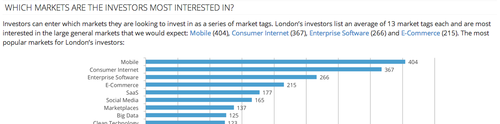
It's certainly trendy to say that you're interested in mobile if you're a tech investor. Actually if you don't say it, you look stupid. But it's much harder to believe it to the extent of putting money in pure mobile companies.
Most successful mobile companies have been riding the wave of the mobile market as an industry, such as mobile advertising networks, mobile technology platforms, mobile marketing services (AppGratis-like) or mobile analytics websites.
Some have created great companies around flagship mobile apps, but mostly as a cross-platform service, not necessarily mobile-first (Evernote, Dropbox, Airbnb…).
Pure mobile apps generally didn't make much revenue and ended up selling in small acqui-hires (Batch, Sparrow, most of Yahoo recent acquisitions…)
Finally, those apps who are really making revenue and can be found in the "Top Grossing apps" in the app store are mainly games and dating apps. Investors generally don't like to invest in gaming companies (say it's hit-driven, like DrawSomething and capital intensive). And they also don't particularly like dating apps (both for some moral obligations for them or their LPs and because it requires a lot of marketing investments).
Then there is a rare breed of social apps with crazy growth like Instagram or Snapchat: these are the only pure mobile companies investors really like and seek out. But they don't integrate mobile ad networks as it would probably make them look a lot worst than having zero revenue with hot metrics.
To round it all up: congrats to MoPub but I hope there will be a better model for mobile entrepreneurs to sustain the development of their companies. Otherwise it will end up like Spotify: a cool growing startup baking a big cake while thousands of artists only get little slices of a few bucks with no other option for distribution.